How it works
From policy setup to evidence-backed report
Define your compliance rules, organize them into a policy, then run automatic checks against every campaign.
Define your compliance rules
Create individual rules that capture each check your policy requires — a required logo, a maximum bonus-to-terms size ratio, an approved link list, a required disclaimer phrase.
Asset presence, text detection, link validation, prominence ratio, AI-assisted content checks.
Set numeric thresholds (e.g. terms text must be ≥ 50% of headline height) or pattern matches.
Organize rules into a Rule Set
Group related rules into a Rule Set that represents one complete compliance policy — for example, one Rule Set per market, brand, or campaign type.
Run different policies for different markets or email types without reconfiguring.
The same rule can belong to multiple rule sets — define once, use everywhere.
Send an email, HTML, or image
Trigger a compliance run by sending a real email to a unique address, submitting HTML through the API, or uploading a rendered image.
Send a real marketing email to a unique compliance address. No integration required.
Submit an HTML template through the REST API from your campaign build tool.
Upload a rendered screenshot for visual-only compliance runs.
Create a Compliance Run
The platform creates a new run record, attaches your chosen Rule Set, and queues the email for processing.
Render and extract visible content
The email is rendered as a recipient would see it. Text is extracted from the visual output — including content embedded inside images using computer vision.
Apply your Rule Set
Each rule in your compliance policy is evaluated against the visible content. Evidence — including annotated screenshots — is captured for every finding.
Review evidence-backed results
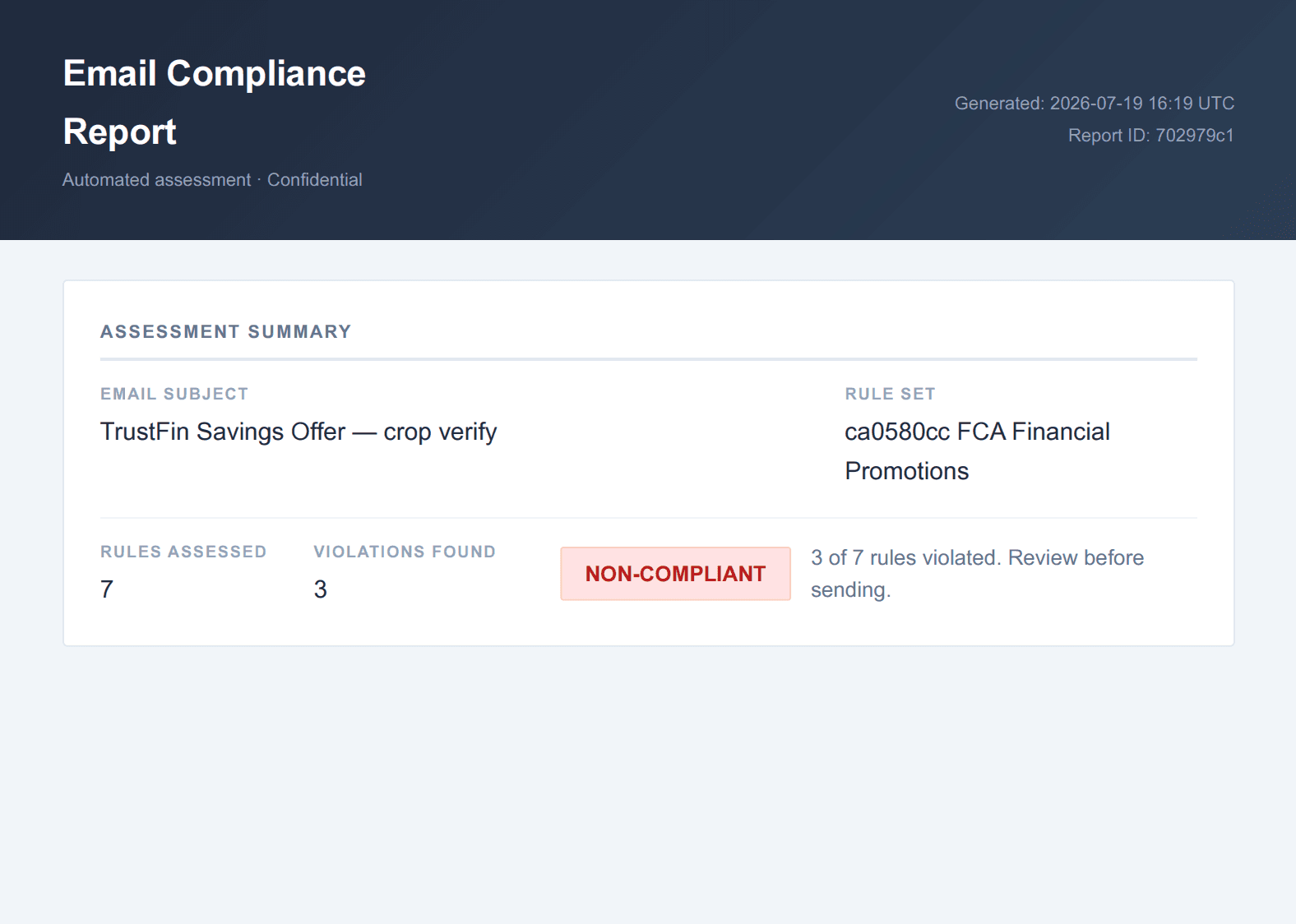
A PDF audit report is generated with pass/fail outcomes and the evidence behind each verdict. Reviewers see exactly what was checked, what was found, and why.
What you get
A real compliance report